


Overview
Objective: You understand the scope of the course, the progression and what must be done after the online part.
Estimated time: 5 min
The course covers the basics of safe use of work equipment: angle grinders, bolt guns, nail guns, drills, rotary and demolition hammers, saws and hand-held concrete saws.
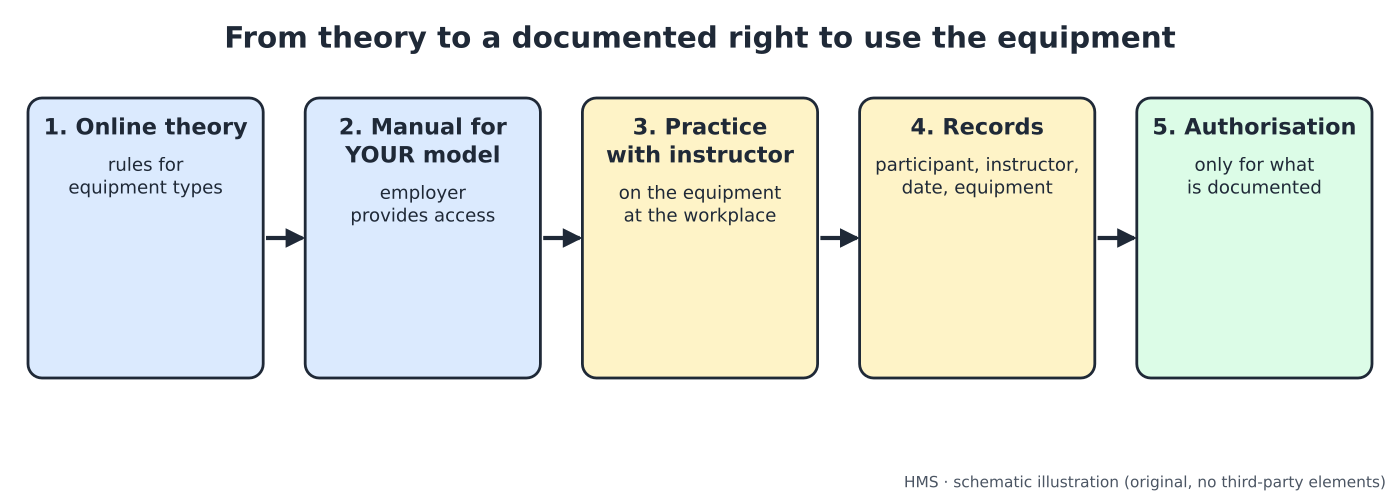
Diagram description (text)
Horizontal diagram with five boxes joined by arrows: 1 online theory, 2 the manual for the specific model provided by the employer, 3 practice with an instructor on the workplace equipment, 4 records (participant, instructor, date, equipment), 5 authorisation only for the documented scope.
What you get in this part
- Theoretical knowledge of each type of equipment: choice of accessories, hazards, PPE, inspection, stopping and faults.
- In the topics — scenarios with an expandable walkthrough for self-checking (not graded).
- One final test after all the lessons (pass mark 80%).
- Two practical lessons led by a competent person appointed by the employer: identification of equipment and an SJA with a demonstration.
What this part does NOT give you
The online test does not mean the right to work independently. You need the manual for the specific model, practice together with an instructor on the workplace’s equipment and documentation of the training.[1][2] Work only within the tasks you have been given, and when conditions change, protection is missing or you do not understand the manual — stop work and report.
How you work through the course
- Open the course programme and begin with the first lesson.
- In each step you read the objective, the diagram and the “Stop work” box; you can check the scenarios by opening the walkthrough.
- After the lessons you take the final test; if you get an answer wrong, you read the explanation and go back to the topic indicated.
- You do the practical lessons together with a competent person appointed by the employer.
- The employer is responsible for training on the specific equipment and for documenting it (sections 10-2 and 10-4).
Values in the course
| Quantity | Value in Norway |
|---|---|
| noise (group III — machines and noisy equipment) | LEX,8h: 80 dB lower action value, 85 dB upper action value and limit value; peak 130 dB(C). Hearing protection is provided >80 dB, mandatory >85 dB or >130 dB(C). Groups I and II have lower limits (55 and 70 dB)[3][4] |
| hand-arm vibration A(8) | 2.5 m/s² action value (section 3-1); 5.0 m/s² limit value (section 3-2); A(8) depends on the tool in use and the working time |
| emergency numbers | 113 ambulance, 110 fire, 112 police[5] |
Sources (5)
- Arbeidstilsynet — Regulations on the performance of work (Forskrift om utførelse av arbeid)
- Arbeidstilsynet — Documented, certified and equipment-specific training (Dokumentert, sertifisert og utstyrsspesifikk opplæring)
- Arbeidstilsynet — Regulations on action values and limit values (Forskrift om tiltaks- og grenseverdier)
- Arbeidstilsynet — Noise (Støy)
- Nkom — Emergency numbers and emergency calls (in Norwegian)